What golf ball should beginners use?
Beginners should use a golf ball that is affordable, reasonably soft and easy to find.
You do not need a tour ball when you are still losing a few each round. You need something that feels decent, launches easily and does not make every bad hole expensive.
The best beginner golf ball is usually the one you can play without worrying about losing it.
Start with price
This is the biggest factor for most beginners.
If you are losing three, four or five balls a round, premium golf balls make very little sense. You will not get enough benefit from them to justify the cost.
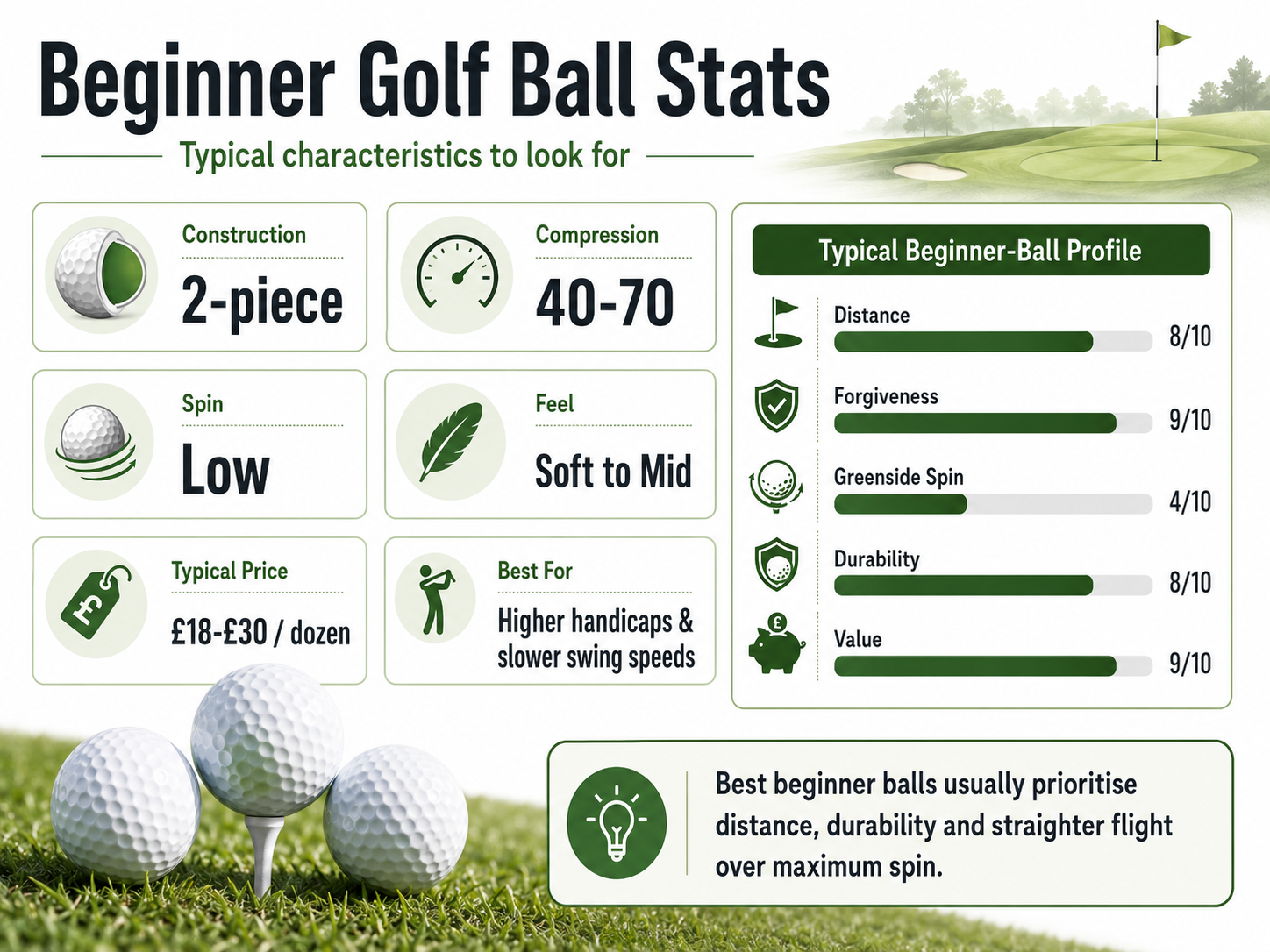
A cheaper two-piece ball is usually the best place to start.
These balls tend to be:
More affordable
Durable
Easy to launch
Lower spinning with the driver
Good enough around the greens for a new golfer
The goal is not to buy the cheapest ball available. It is to avoid paying premium prices for performance you may not yet notice.
Use a softer-feeling ball
A softer ball is often easier for beginners to enjoy.
It usually feels better off the putter and on shorter shots, especially if your swing speed is not particularly high.
That does not mean every beginner needs the softest ball possible. It just means there is little reason to use something that feels hard and unpleasant unless you genuinely prefer it.
A good beginner ball should feel comfortable rather than impressive.
Two-piece balls are usually the best choice
Most beginners are better off with a two-piece golf ball.
A two-piece ball normally has a solid core and a durable outer cover. It is designed to offer distance, durability and lower spin from longer clubs.
That matters because extra side spin can make a slice or hook worse.
A lower-spinning ball will not fix a poor swing, but it may reduce how far offline the ball travels.
Why two-piece balls suit beginners
They are usually:
Cheaper than premium multi-layer balls
More resistant to scuffs
Longer-lasting
Easier to launch
Less demanding
More forgiving from the tee
They also remove one more thing to overthink.
Do beginners need a premium golf ball?
Usually, no.
Premium balls are designed to offer more control, feel and spin, especially on approach shots and around the green.
That is useful for better players who can control strike, flight and spin.
For a beginner, the difference is often much smaller than the price suggests.
You are more likely to lower scores by:
Keeping the ball in play
Avoiding penalties
Learning basic distance control
Improving putting pace
Choosing sensible targets
A premium ball cannot rescue a poor decision or a ball hit out of bounds.
Should beginners use lake balls?
Lake balls can be cheap, but they are not always consistent.
Some may have been in water for a long time. Others may have surface damage that is not obvious straight away.
For practice, they can be fine.
For rounds where you want to judge your own improvement, a consistent new ball is usually better.
The issue is not that every lake ball is bad. It is that you do not always know what you are getting.
Refurbished balls are not the same as new balls
Refurbished balls are often repainted or recoated.
They may look new, but the original surface and markings can be altered.
That can affect feel and consistency.
For a beginner, this may not ruin the round, but new budget balls are often a safer buy if the price is close.
Used balls from a trusted grade can still be practical, especially for practice. Just avoid paying near-new prices for something heavily restored.
Should beginners use coloured golf balls?
Yes, if they are easier for you to see.
Yellow, orange and other bright colours can help in poor light, rough or autumn conditions.
There is no scoring penalty for using a coloured ball. Visibility is more useful than tradition.
A ball you can find quickly is a good ball.
White balls are still fine, but beginners should choose whichever colour makes tracking the flight and finding the ball easier.
Does compression matter?
Not as much as some golf ball marketing makes it sound.
Compression refers to how much the ball deforms at impact.
Softer, lower-compression balls are often recommended for slower swing speeds. Firmer balls may suit faster swings or players who prefer a sharper feel.
For most beginners, the practical difference is simple:
Pick a ball that feels comfortable
Avoid paying extra based only on a compression number
Do not assume a harder ball automatically goes further
Do not assume a soft ball will fix poor contact
Strike still matters far more.
What about distance balls?
Distance balls can suit beginners, especially if you struggle to get the ball moving.
They are usually designed to reduce spin and produce a strong flight.
That can help from the tee, but some feel firmer around the greens.
There is always a trade-off.
A distance ball may give you:
Lower driver spin
More roll
Better durability
A firmer feel
Less short-game control
For a beginner, that is often acceptable. The priority is usually getting the ball forward and keeping it in play.
Should beginners use the same ball every round?
Yes, where possible.
Using the same model helps you understand how it behaves.
Changing between a soft budget ball, a firm distance ball and a premium urethane ball can make judging feel and distance more difficult.
Consistency helps with:
Putting pace
Chip shots
Wedge distance
Driver flight
Confidence
You do not need to stay loyal to one ball forever. But once you find one that feels right and fits your budget, use it for a few rounds.
What should a beginner look for on the box?
Ignore most of the dramatic claims.
Look for simple wording such as:
Soft feel
Low spin
Two-piece construction
Distance
Durable cover
Low or mid compression
Suitable for moderate swing speeds
You do not need a ball promising maximum spin, tour-level control and penetrating flight.
At beginner level, simple is better.
How many golf balls should a beginner carry?
Carry enough that losing a few does not become a problem.
For most beginners, that means around:
Six balls for a short or familiar course
Nine balls for a normal round
Twelve balls if you are still losing several regularly
You do not need to fill every pocket with them. You just do not want to reach the 14th tee and realise you have one scratched ball left.
Also mark your ball before playing. Beginners are more likely to hit into shared areas, so being able to identify it matters.
When should you move to a better golf ball?
You should consider upgrading when you start noticing the limitations of the ball you are using.
That might be when:
You are losing far fewer balls
Your strike is more consistent
You can control chip and pitch shots
You notice differences in feel
You want more spin into greens
You can justify the extra cost
Do not upgrade because someone else says your current ball is basic.
Upgrade when you can actually use the extra performance.
What beginners should avoid
Some golf ball choices make little sense early on.
Avoid:
Expensive tour balls when you lose several per round
Mixing completely different balls during the same round
Buying purely because a professional uses them
Assuming the softest ball is automatically the best
Assuming a premium ball will straighten your slice
Using badly damaged balls for serious rounds
Paying too much for refurbished balls
The ball matters, but not as much as the swing, decision and strike.
A sensible beginner setup
A good starting point is:
A new two-piece ball
Soft or medium feel
Lower driver spin
Durable cover
Bright colour if visibility helps
Affordable enough to replace
Buy one dozen, use them for several rounds and see how they behave.
Pay attention to:
How they feel off the putter
Whether they are easy to launch
How quickly they scuff
Whether you can see them clearly
Whether you mind losing them
That tells you more than the claims on the box.
Track whether your ball is actually helping
It is easy to blame the ball after a bad round.
Usually, the real cause is something else.
FootWedge can help you track your rounds, scores and FootWedge handicap over time. You need to sign up for an account to get a FootWedge handicap.
That makes it easier to see whether your scoring is improving rather than judging everything from one round.
If you change golf ball, pay attention to:
Penalty shots
Tee-shot consistency
Approach distance control
Three-putts
Short-game confidence
Balls lost per round
A ball change should make the game feel simpler, not give you another thing to worry about.
So, what golf ball should a beginner use?
Most beginners should use an affordable two-piece ball with a soft or medium feel and a durable cover.
It does not need to be premium.
It needs to be consistent, easy to find and cheap enough that losing one does not ruin your mood.
Once your strike improves and you start losing fewer balls, you can think about moving to something with more feel and short-game control.
Until then, keep it simple and spend the difference on playing more golf.